

Maruchi WOTOGBE, Olugbemisola SAMUEL, Blessing AGBULU, and Mahfus DAUDA
DDP Research and Knowledge Management Unit
Development Delivery Partners Inc.

Where Does Nigeria Stand?
Education is more than schooling; it is a human right, a public good, and the backbone of national development [1,2]. In a world where artificial intelligence (AI) and digital technologies are rapidly reshaping how people learn, work, and live, education systems must evolve or risk leaving millions behind. UNESCO has consistently emphasized that technology should expand opportunities in education rather than deepen existing inequalities [3]. For Nigeria, this message could not be more urgent.
Despite clear national and global benchmarks, education remains chronically underfunded in Nigeria. UNESCO recommends that at least 26% of national budgets be allocated to education [4]. This position is reinforced in Nigeria’s National Policy on Education, which emphasizes sustained public investment as a prerequisite for quality and equitable learning outcomes [5]. Yet in 2025, combined federal and state spending on education averages only about 9.27%, far below recommended levels [6,7]. This persistent funding gap signals a systemic undervaluing of education at a time when investment should be increasing.

A Tale of Winners and Laggards
A closer look at education financing across Nigeria in 2025 reveals sharp contrasts across states. While states such as Nasarawa, Kwara, Kogi, and Oyo allocated relatively higher proportions of their budgets to education, several others including Enugu, Plateau, Ebonyi, Edo, Lagos, and Niger allocated significantly lower shares, often below 10% [7,8]. These differences highlight uneven prioritization of education across the federation.
Encouragingly, some states demonstrate that political commitment and administrative capacity can improve outcomes. Bayelsa, Ekiti, and Kwara stand out for either committing higher budgetary shares to education or ensuring that approved funds are actually utilized [8]. However, allocation alone does not guarantee impact. Analysis of 2025 Q1–Q3 education budget utilization shows that while Bayelsa (89%), Ekiti (83.2%), and Yobe (78.6%) recorded relatively strong utilization rates, states such as Cross River (16%), Abia (18.3%), and Zamfara (21.8%) utilized less than a quarter of approved education funds [7].
This contrast underscores a critical lesson: Nigeria’s education crisis is not only about how much money is budgeted, but also about how effectively those funds are used. Without improvements in both allocation and execution, disparities in learning outcomes across states will continue to widen, undermining national development goals.
Technology, AI, and the Reality of Primary Education
Artificial intelligence refers to computer-based systems capable of learning from data, adapting to new inputs, and supporting decision-making. In education, AI can enable personalized learning, adaptive assessment, and improved planning by education authorities [9]. In theory, these tools could help Nigeria address persistent challenges in primary education, including learning poverty, teacher shortages, and weak monitoring systems.
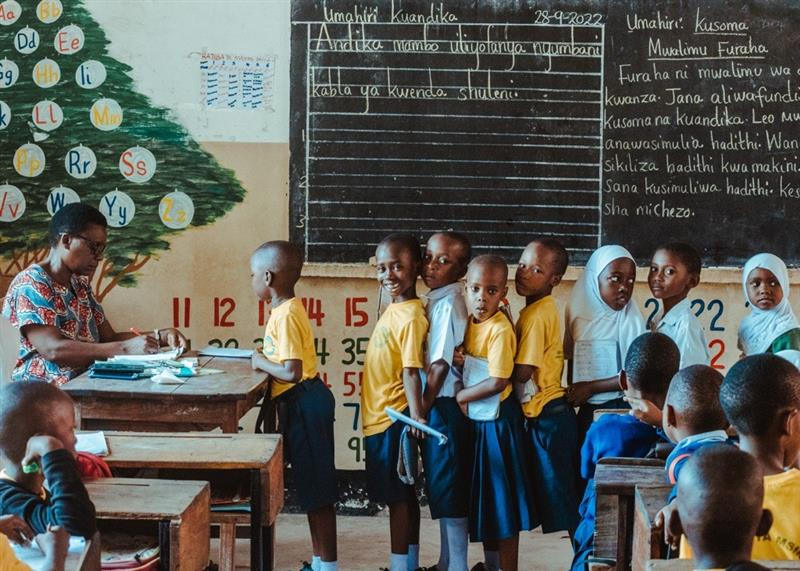
In practice, however, the use of technology and AI in Nigeria’s public primary schools remains limited. Many schools lack basic infrastructure such as electricity, internet connectivity, and digital devices, particularly in rural and underserved communities [10,11]. Where technology exists, it is often driven by private schools or donor-funded pilots, reinforcing inequalities between public and private education and between urban and rural learners.
UNESCO stresses that technology should support teachers rather than replace them [3]. Yet teacher preparation for digital and AI-supported pedagogy remains weak in Nigeria [12]. Without sustained investment in teacher capacity, infrastructure, and governance, AI risks becoming another driver of exclusion rather than a tool for educational equity.
Why Nigeria’s Youth Matter More Than Ever
Nigeria’s youth represent a critical asset in navigating this transition. Young people are already shaping the education landscape through edtech startups, digital learning platforms, coding clubs, and community-based literacy initiatives [13]. These youth-led innovations ranging from low-cost learning applications to online tutoring and curriculum-aligned digital content are filling gaps left by limited public provision.
Beyond innovation, youths are also powerful advocates for reform. Through social media engagement, civil society participation, and grassroots organizing, they are demanding better funding, transparency, and accountability in education [14]. However, to fully unlock this potential, youths require access to financing, mentorship, digital infrastructure, and meaningful inclusion in policymaking processes [15].

A Call to Action: Aligning Stakeholders Around a Shared Vision
Nigeria’s education transformation requires coordinated action across all levels of government and sustained collaboration with development partners. The strategic blueprint articulated by the Honourable Minister of Education, Dr. Tunji Alausa, which emphasizes expanded access, improved quality, relevance to labour market needs, skills for the future, data-driven governance, and strong partnerships, provides a timely framework for reform[16]. Therefore, the following call to action are required from all key stakeholders;
Federal Government
- Increase education financing progressively toward global benchmarks, with explicit protection for basic and primary education.
- Mainstream AI and digital learning within national education strategies, ensuring equity and inclusion.
- Strengthen national education data systems to track financing, learning outcomes, and technology deployment.
State Governments
- Improve both budgetary allocation and utilization for education.
- Invest in foundational digital infrastructure for public primary schools, particularly in rural and underserved areas.
- Strengthen transparency and accountability mechanisms for education spending.
Federal, and State Ministries of Education
- Integrate digital literacy and AI awareness into teacher education and continuous professional development.
- Ensure technology adoption remains teacher-centered and curriculum-aligned.
- Use data systematically for planning, targeting, and performance monitoring.
Implementing Partners and Civil Society Organizations
- Support scalable, evidence-based interventions rather than fragmented pilots.
- Build state and local capacity for implementation, monitoring, and evaluation.
- Elevate youth-led and community-driven education solutions.
Foreign Donors
- Align funding with national and subnational education priorities.
- Invest in foundational systems of teacher capacity, infrastructure, and data alongside innovation.
- Commit to long-term system strengthening rather than short-term technology deployments.
The Bottom Line
Nigeria stands at a crossroads. Education remains underfunded; technology adoption is uneven, and learning outcomes are fragile. Yet the pathway forward is clear. With improved financing and utilization, teacher-focused technology policies, and deliberate support for youth-led innovation guided by the Minister’s strategic vision, AI and digital tools can strengthen education rather than deepen inequality.
The question is no longer whether Nigeria can afford to invest in education and technology, but whether it can afford not to.
References
- United Nations. Universal Declaration of Human Rights. New York: United Nations; 1948.
- United Nations. Transforming Our World: The 2030 Agenda for Sustainable Development. New York: United Nations; 2015.
- Guidance on Artificial Intelligence and Education. Paris: UNESCO; 2021.
- Education 2030: Incheon Declaration and Framework for Action. Paris: UNESCO; 2016.
- Federal Republic of Nigeria. National Policy on Education. 6th ed. Abuja: Nigerian Educational Research and Development Council; 2014.
- Budget Office of the Federation. 2025 Approved Federal and State Budget Analysis. Abuja: Federal Government of Nigeria; 2025.
- State of States 2025: Education Financing and Budget Performance. Lagos: BudgIT; 2025.
- National Bureau of Statistics. State Government Budget Allocation and Utilization Reports. Abuja: NBS; 2025.
- Artificial Intelligence in Education: Challenges and Opportunities. Paris: OECD Publishing; 2021.
- Digital Learning and Equity in Nigeria. Abuja: UNICEF Nigeria; 2022.
- World Bank. Nigeria Digital Economy Diagnostic Report. Washington (DC): World Bank; 2023.
- UNESCO Institute for Statistics. Teacher Preparedness and ICT Skills in Sub-Saharan Africa. Montreal: UIS; 2022.
- EdTech and Youth Innovation in Nigeria. London: GSMA; 2023.
- British Council. Youth, Civic Engagement, and Education Reform in Nigeria. Abuja: British Council Nigeria; 2022.
- World Economic Forum. Empowering Youth for the Future of Education and Work. Geneva: WEF; 2023.
- Federal Ministry of Education. FG launches 2025–2027 Communication Strategy and Framework: a blueprint for Nigeria’s education reforms. Press release, Federal Ministry of Information and National Orientation; 2026 Jan 19 [cited 2026 Jan 23]. Available from: https://fmino.gov.ng/fg-launches-2025-2027-communication-strategy-highlights-major-education-achievement